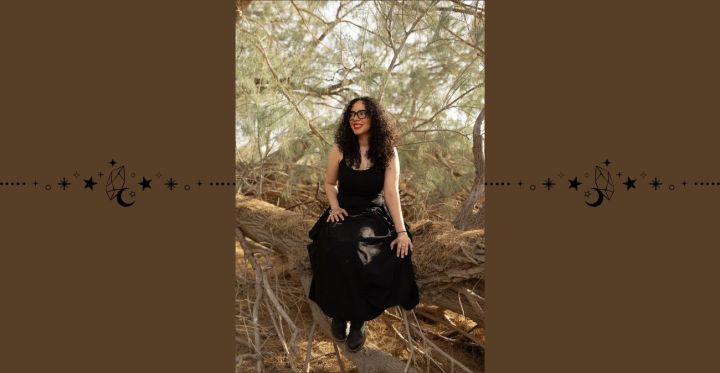
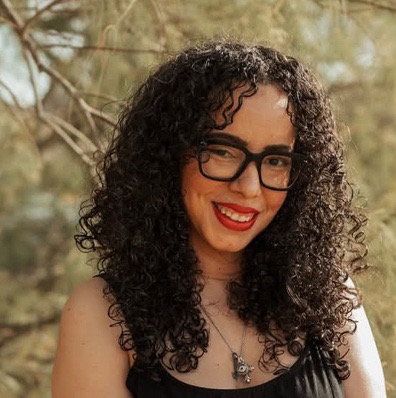
Award-winning author Johanny “Joa” Ortega writes stories that span multiple genres, including horror, gothic, and psychological suspense. She also shows a lighter side with her middle-grade fiction. Born in the Dominican Republic and raised in the United States, Ortega draws on her experiences to explore themes such as identity, multicultural families, ancestral memory, the female experience, and emotional ghosts.
A love of books has been a significant part of Ortega’s life, and she learned English through reading. She discovered captivating stories but realized there was a lack of representation. She didn’t come across many books about Dominican women or immigrant families. So, she decided to write the stories that she wanted to see more of.
Ortega started off writing blog posts, essays, and short stories. Her writing has evolved and now includes longer works of fiction and novels. She doesn’t shy away from stories that address generational trauma, cultural identity, queerness, and womanhood. Her latest book, The Ordinary Bruja, is a horror tale that incorporates magical realism. It weaves together family secrets, Indigenous mysticism, and Dominican folklore.
Her fiction has made an impact and received notable recognition. Her middle-grade novel Mrs. Franchy’s Evil Ring and the Six Months That Changed Everything won First Place in Juvenile Multicultural Fiction and Second Place in Juvenile Social Themes Fiction at the Fall 2024 BookFest Awards.
If you’re a California reader, you can help get the author’s book The Ordinary Bruja into The Golden State’s libraries. To learn how to request copies at your local library, check out her blog post, The Ordinary Bruja Is Heading to California Libraries, for details.
Johanny Ortega is an author whose voice we need to hear more of in fiction. I had the pleasure of interviewing her to learn more about her craft and experience creating stories. We talk about her attraction to horror, Dominican brujería, upcoming appearances, and more!
Q: One of the genres you write in is horror. What introduced you to horror? Was it a book or movie? Also, what fascinates you about the genre?
A: My introduction to horror happened in the ’90s, in my uncle’s apartment in New York, watching horror movies on HBO through his hot box.
I remember sitting with my cousins, watching movies like Friday the 13th, A Nightmare on Elm Street, Pet Sematary, and Fright Night. You know, the classics! And I remember turning away from the television or hiding underneath the covers whenever shit got too scary. But did I stop watching? Of course not!
The funny thing is, I didn’t even know English back then. I couldn’t understand half of what those people were saying, but let me tell you, I understood fear perfectly well. Jason didn’t need subtitles to scare the living hell out of me. Neither did Freddy Krueger.
I’ll never forget those nights. The excitement of watching something terrifying with my cousins, knowing I was probably going to regret it when it was time to sleep.
And here’s the funny part: I’m still a scaredy-cat.
I love supernatural horror, especially ghosts, but I draw the line at religious horror involving possession. That’s because of something my grandmother told me growing up. She believed evil spirits could attach themselves to your soul if you gave them too much credence by watching certain movies or consuming certain kinds of media.
That stayed with me. Ghosts? Sure. Possession? No, gracias.
But lo and behold, I ended up writing a possession scene in The Ordinary Bruja.
So contradictory, right? But let me tell you—anger.
For as long as I can remember, anger has propelled me…
It’s either that “I’ll show them” mentality or the occasional “fuck ’em all to hell” that has pushed me to some of my greatest accomplishments. And when a whole bunch of Dominican trolls ganged up on me in the comments on Instagram because they wanted to retain their whitewashed version of history, something in me snapped.
But I don’t snap in the physical sense. I snap on the page.
That anger broke something open in me, and suddenly horror became a real possibility. I could take all that rage, all those uncomfortable truths, and give them a home in fiction.
What fascinates me most about horror is that the most terrifying things aren’t always supernatural. Sometimes they’re the things we do to ourselves and the things we’ve been taught to believe.
Because what could be more horrifying than a person who has forgotten who they are? Someone who has forgotten their ancestry and, in doing so, willingly given away their power?
To me, that’s more terrifying than possession.
That’s what I wanted to explore with Marisol Espinal in The Ordinary Bruja. She’s a Dominican woman who doesn’t want to be a bruja. She shuns her mother and her teachings because everything her mother represents embarrasses her. Marisol wants to blend into whiteness, but the brown edges of her culture keep making her stand out. So she snuffs them out, little by little, until she forgets they were ever there.
But when the voices begin calling her from the hill, she can only deny them for so long.
Marisol’s journey becomes a painful reclamation of everything she willingly discarded to fit in. It’s almost like someone cutting pieces of their own skin away because everyone around them looks different, and they believe they should look that way, too. Then, when they finally realize what they’ve done, they have to sew those pieces back on.
And as Marisol metaphorically sews her skin back together, she discovers that the very things she rejected are what she needs to fight the hill and save her best friend.
That’s horrifying to me. Realizing that what you needed all along was what you had been taught to hate about yourself.
It’s what I felt when I began shedding the colonized lies I grew up believing. And perhaps that’s why those trolls angered me so much. I had already gone through the painful process of questioning those lies, only to come face-to-face with people still perpetuating them.
So yes, anger pushed me toward writing horror. But what keeps me fascinated with the genre is its ability to expose the horrors we normalize, especially the ones we carry inside ourselves.
And by the way, no genre is off-limits for me. Just as I’m a mood reader, I’m a mood writer, per se. Whatever the story merits, that’s what the story will be.
Q: Your recent novel, The Ordinary Bruja, incorporates magical realism and centers on Dominican brujería. Can you talk a bit about magic and brujería in Dominican culture?
A: I’ll always remember my grandmother on my father’s side whipping my sister and me with a branch from a tree because we took offerings from the saints’ altar.
“Don’t you ever steal from the saints,” she told us.
And then there was my grandmother on my mother’s side, who made promises to her Catholic saints and God himself in exchange for things she wanted to come true. Once, she promised that she would enter a church on her knees. What I hadn’t realized was that her promise apparently included my sister and me. So, on our knees, we went into church that day.
When I think about magic and spirituality in Dominican culture, I think about those experiences.
Brujería, folk spirituality, Catholicism, and ancestral beliefs have long existed alongside one another in Dominican culture, sometimes blending together and sometimes clashing. What one person considers devotion, another might call superstition or even witchcraft. And those differences can exist within the same family.
For me, magic and spirituality have always been this sometimes painful business of bargaining with the entities that push and pull at the universe.
I ask for something, and I give something in return. And when I don’t fulfill my end of the bargain, there’s this understanding that the saints will ensure a balance is reached, a lo bueno o a lo malo.
That’s how I experienced spirituality growing up. There were offerings, promises, prayers, consequences, and this understanding that something greater than us was listening.
But there was also fear. Fear of offending a saint, breaking a promise, or inviting something into your life that you couldn’t easily get rid of.
I find that fascinating, especially because those beliefs can be so personal. Two people can grow up in the same Dominican household and come away with completely different understandings of what is sacred, what is magic, and what is forbidden.
That tension is something I explore in The Ordinary Bruja. What happens when the very practices you’ve been taught to fear or dismiss are also part of your inheritance?
I pray, and I bargain, hoping to receive what I want. But sometimes what I receive is what I need.
And sometimes those are two very different things.
Q: What inspired you to write The Ordinary Bruja and turn it into a book series called Las Cerradoras? Do you have a clear vision of how you want the series to unravel, or is that something that’s evolving as you work on each book?
A: Anger pushed me. My lived experiences inspired me.
I now have a clear vision for Las Cerradoras, and honestly, figuring that out was easier than I thought it would be. But that’s probably because The Ordinary Bruja, although it’s the first published book, is chronologically the last story in the trilogy.
I’m currently editing the second book, The Forgotten Bruja, which is chronologically the first story. The third book, The Reluctant Bruja, will complete the middle of the family’s history. Confusing? A little. But I promise it makes sense!
What makes the series work for me is that I know what each protagonist must confront, even though the specifics of their journeys continue to evolve as I write.
In The Ordinary Bruja, Marisol must confront herself. She has spent so much of her life rejecting parts of her identity that she cannot come into her power until she accepts all of herself, including the parts she was taught to be ashamed of.
In The Forgotten Bruja, Isadora must contend with the meaning of freedom. Is freedom running away and doing whatever you want? Or is it accepting what you must do, even when that choice comes at a tremendous personal cost?
And in The Reluctant Bruja, Josefina will have to make one of the hardest choices a mother can make: trusting her daughter to finish something she herself could not. Readers of The Ordinary Bruja already know where that decision eventually leads, but what they don’t know is how Josefina loses herself in motherhood and what it will take for her to reach the other side of that dilemma.
And let me tell you, that journey is going to be chaotic.
You see, I draw from experience in all of this.
I lost myself in the role of motherhood. When my son left for college, I suddenly realized I didn’t even know who I was outside of being his mother. This person who had essentially determined the rhythm of my entire day was now gone, living his own life, as he should. But where did that leave me?
I also know what it’s like to lose myself in whitewashed histories and colonized lies, only to have to confront those beliefs and the people who still cling to them.
And I know what it’s like to run away from family, believing that distance equals freedom, only to come back with the realization that I can love my family while still establishing boundaries.
So I take the truths I’ve learned, wrap them in fiction, horror, and magical realism, and give them to characters carrying wounds similar to mine.
Then I walk alongside them as they navigate their journeys, only theirs are filled with magic, spirits, ancestral power, and the occasional terrifying hill.
I know where the series is going. What continues to surprise me is how much these women teach me along the way.
Q: What authors or stories have influenced your craft and passion for creative writing?
A: Octavia Butler is an enormous influence on me.
She taught me that writing doesn’t have to be super packed to still pack a punch. That lady knew how to write concisely and still drive her point across. Every word mattered.
I tend to be an underwriter, so reading her books gave me a lot of hope when I was starting out. She showed me that I didn’t need to write endlessly to tell a story with depth, meaning, and impact.
Then there’s Claribel A. Ortega. I read her middle-grade series Witchlings while I was writing my first book. And let me tell you, reading a Dominican author always feels like a warm hug to me. I feel so seen!
There’s something special about finding pieces of your culture in a book without those pieces being explained as though they’re strange or foreign. They’re simply part of the world, part of the characters, and part of the story. I love that.
And for sure, Certain Dark Things by Silvia Moreno-Garcia was a WOWOWOWOW moment for me.
I remember thinking, “Who is this author writing this beautifully weird mash-up of a book, and how can I do that?”
It was so different from what I was accustomed to reading, and I loved every bit of it. When I continued exploring her other books, I realized something important: I don’t have to stick to one genre.
I can write horror, fantasy, magical realism, realistic fiction, or mash them together if the story calls for it.
And that realization was incredibly freeing.
Q: As a Dominican author, you’re helping to amplify the voices of the Latine and BIPOC communities. Your work also delves into queerness. What do you hope your stories do for those who feel underrepresented?
A: I always pray, right before I hit publish, that those who feel unseen will find a mirror in my books.
When I first came to the United States, there weren’t many books where I could see myself. Actually, there weren’t any that I encountered, at least not until I reached adulthood.
And that absence stayed with me. You know?
I think when we grow up without seeing people who look like us, sound like us, love like us, or come from families like ours in the stories we consume, we may begin to wonder whether there’s room for someone like us in this world.
I felt that. And I think that’s why I spent so much of my childhood and young adulthood hiding behind different masks, trying to fit into spaces where I didn’t feel I belonged. Until, eventually, I got tired of pretending and said, “Fuck it. This is me.”
But getting to that point was confusing, exhausting, and, at times, downright chaotic. I had to unlearn so much of what I’d been taught about myself, my culture, and what it meant to belong. And I wouldn’t want someone else to have to go through all of that. Not in the year of our Lord 2026, when so many of us have begun awakening from that colonized nightmare, questioning the narratives we inherited, and learning to accept ourselves and others.
If I can help it, I don’t want another young reader to feel that way.
I want the Dominican girl who speaks Spanglish, the queer girl who feels different, the brown girl who doesn’t quite fit into anyone’s expectations, to pick up one of my books and recognize herself. Not as a side character. Not as someone who exists only to suffer. But as someone whose life, love, anger, mistakes, and victories deserve to be at the center of a story. And I want her to know that she doesn’t have to erase pieces of herself to belong.
Writing and publishing can be such a long, doubtful process. There are moments when I question everything. But I hold on to that little girl inside me who wished there were books where the weird, queer girl won in the end.
I write for her, and I hope that somewhere out there, another reader finds the pieces she’s lost in one of my books.
Q: Are there any projects or event appearances you have in the works that you’d like people to know about?
A: Oh, absolutely!
This year, I made it a point to put myself out there, and I have no regrets! I’ve been attending book festivals, author markets, and community events, meeting readers, talking about my books, and getting to know other authors. As an introvert, that has been quite the adventure, but one I’m happy I pushed myself to experience.
I’m also working on the second book in the Las Cerradoras trilogy, The Forgotten Bruja, which is scheduled for release on April 27, 2027. It’s a Dominican gothic horror novel that takes readers into the past, long before the events of The Ordinary Bruja, to explore the life of Isadora Espinal and the choices that shaped her family’s future.
I’m currently in the editing process, making sure the story gets the care it deserves before publication. And yes, I’m already thinking about the third book, The Reluctant Bruja, because apparently, I enjoy the chaos.
As for events, here’s where readers can find me next:
- December 5, 2026 — The Open Book, Simi Valley, California. Author reading and book signing at 2880-A Cochran Street.
- December 19, 2026 — Nightmare Before Christmas Market. 2:00–9:00 PM at Tarzana Community Center, 19130 Ventura Boulevard, Tarzana, California.
- March 27, 2027 — NovelCon 2027. 6:00 AM–4:30 PM at 5001 N. Scottsdale Road, Scottsdale, Arizona.
- June 12, 2027 — Books in California. 11:00 AM–4:00 PM at Embassy Suites by Hilton Los Angeles International Airport South, Los Angeles, California.
The best way to keep up with all my upcoming appearances is through my events page.
And I always encourage readers to sign up for my newsletter. That’s where I share book updates, cover reveals, behind-the-scenes looks at my writing process, and the occasional exclusive story.
Social media algorithms decide what you see, but my newsletter allows me to stay connected with readers directly.
And I would love to have readers there!
Where to Stalk
Have A Cup Of Johanny official website


Johanny Ortega is certainly an amazing and very talented young author. It was a great interview. Great questions and great answers.
LikeLiked by 1 person
Thank you so much! I’m glad you enjoyed it.
LikeLiked by 1 person
I read The Ordinary Bruja last yr ( recommend it) & a couple of months ago had the pleasure of meeting Joa at a bookfest in LA. Interviews always give such interesting insights to the story behind the story.
LikeLiked by 1 person
That’s awesome! I hope I can meet her in person too next time she’s at an event in LA.
LikeLiked by 1 person