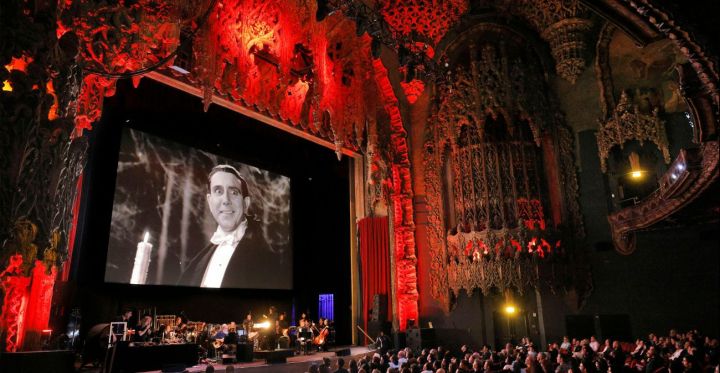

Did you know there is a 1931 Spanish-language film version of Dracula? It was released the same year as the notorious adaptation starring Bela Lugosi. When LA Opera announced this would be their movie selection for Halloween, I was ecstatic. Every year during the last weekend of October, they choose a horror film to play that’s accompanied by live orchestra. I knew this was a rare opportunity I couldn’t miss, and I’m here to share it with you.
It turns out that while the Dracula movie starring Bela Lugosi was being shot during the day, the Spanish version was being filmed in the shadows of nightfall. It was directed by George Melford, and while the cast was different, the same sets and storyline were used. Melford had a bit of an advantage. He would review the raw footage from the English-language film so he could make improvements on his project. It must have paid off because many people feel Melford’s adaptation is the better one.
You may be wondering why the Spanish rendition didn’t receive the same amount of press as its English-language counterpart. There’s really no clear answer. It was released in 1931 but then was forgotten about until the 1970s. Eventually, it was restored. However, it wouldn’t be screened before audiences until 1992 when it was shown at the Director’s Guild.

The original motion picture featured no soundtrack and incorporated barely any sound effects. This was mainly because the movie industry was just beginning to make the switch from silent films to “talkies.” LA Opera commissioned Oscar-winning musician Gustavo Santaolalla to create an entirely new score for the Spanish Dracula. The music completely impacted my viewing experience. But before I get into that, allow me to elaborate on a few other details.


The event was held at The United Theater on Broadway (formerly the Theater at Ace Hotel). This is a stunning historic venue that dates back to the 1920s. The rich ornate décor made it an ideal place to view a horror classic like Dracula. I attended opening night. Guests filled the foyer and excitement buzzed in the air. There were even some attendees dressed in vampire costumes. It was marvelous!


When I entered the theater, I saw the orchestra set up in front of the big screen. Composer Santaolalla was also part of the ensemble. He was playing the electric guitar. They were led by LA Opera’s resident conductor Lina González-Granados. When the lights dimmed and the music began, the entire room went silent. Everyone cheered as soon as the Dracula credits came up signaling it was showtime.
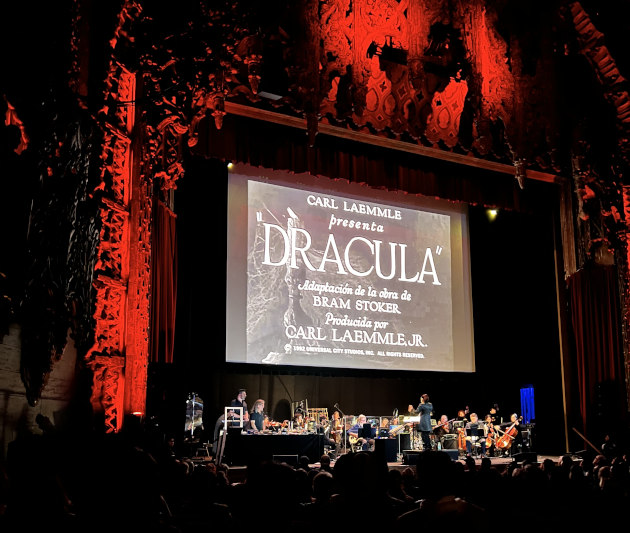
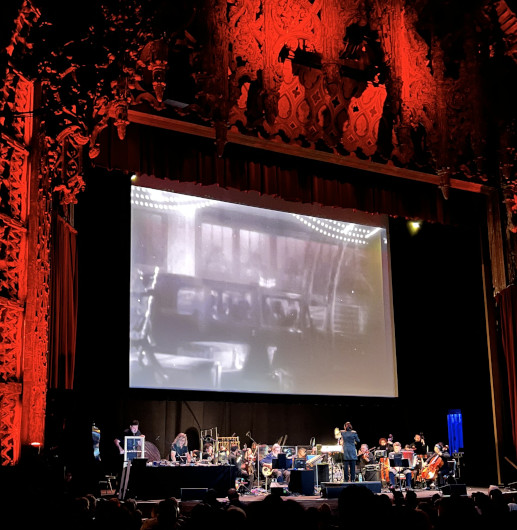
I don’t even know how to begin to describe the music or the effect it had on me. The score possessed a heavy, dark sound that relied greatly on strings. I noticed two individuals in a far corner on one side of the stage who were in charge of creating other sound effects. It was really neat to watch as they used various instruments to mimic the sound of bat wings, paper crinkling and horses galloping. The creation of every sound and musical note was so organic. Plus, the reverberation and vibrations from the music permeating the theater further immersed me in the scenes.
The film itself was captivating and entertaining. Although a horror picture, there were some comedic moments spread throughout. I don’t know if that was done intentionally by the actors, but it worked, and I feel it’s one of the significant differences from the English-language version. Carlos Villarías was mesmerizing as Conde Drácula. His movements and gazes were calculated and magnetic.
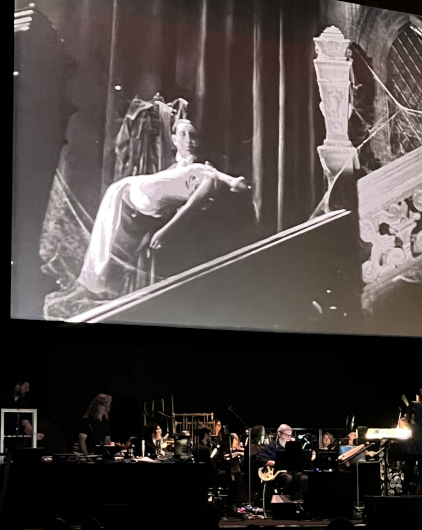
I also must applaud Lupita Tovar who played Eva. Her character was equivalent to Mina. Her performance was playful and risqué, especially for that time. As she gradually succumbs to Dracula’s power, her character becomes sensually charged in an uncensored way. It was interesting to see Melford push the envelope in his production and underscore the sensuality of the vampire energy.
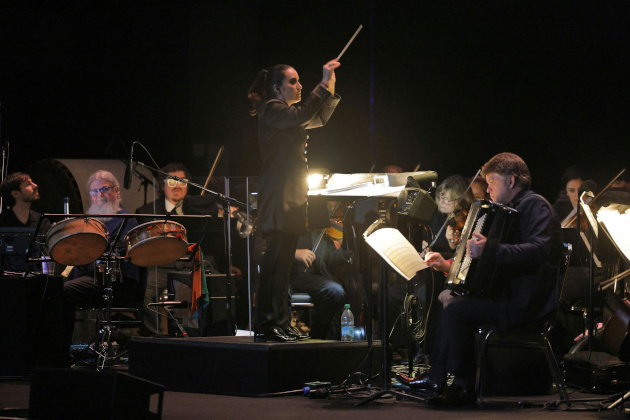
Lina González-Granados (LA Opera’s Resident Conductor) conducting “Spanish Dracula” at the United Theater on Broadway. (Photo: Cory Weaver) 
Lina González-Granados conducts a rehearsal for “Spanish Dracula” at the United Theater on Broadway. (Photo: Cory Weaver) 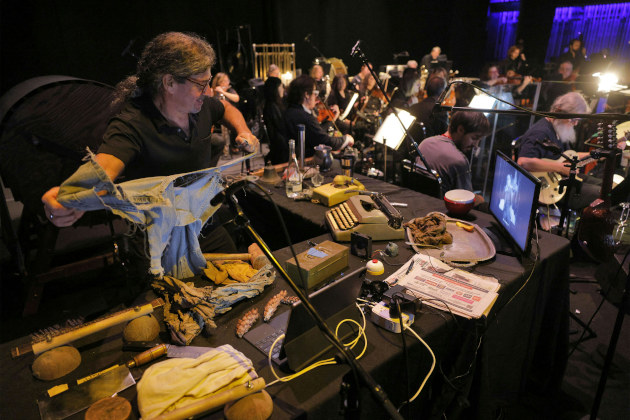
Foley artist Ryan Collison at a rehearsal for “Spanish Dracula” at the United Theater on Broadway. (Photo: Cory Weaver) 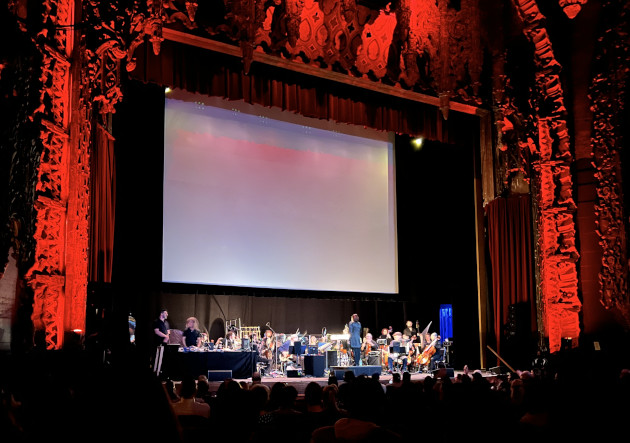
LA Opera Orchestra 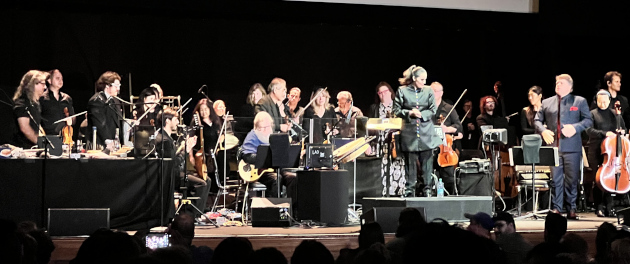
LA Opera Orchestra at the conclusion of Spanish ‘Dracula’
While the Spanish-language Dracula is a great movie on its own, LA Opera’s presentation made it even better. It’s no secret that music sets the mood, and this original score with added sound effects made it an amazing theatrical experience. Not to mention viewing it in a gothic auditorium during the spookiest time of the year. I have to admit watching it in another setting probably won’t have the same effect.
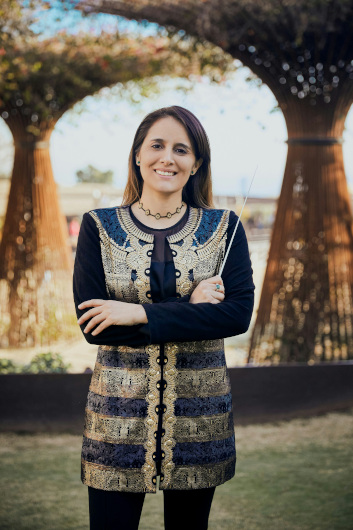
I am beyond grateful that I had the opportunity to attend LA Opera’s screening of the Spanish Dracula. As a Latina, it also brought me so much pride to see a classic work revived by other Latinos. Composer Gustavo Santaolalla is from Argentina and conductor Lina González-Granados is Colombian-American. Female conductors are already rare, so it was awesome seeing a Latina and woman of color lead the orchestra.


My next mission is to find out whether LA Opera plans to release the reimagined soundtrack. It would be great if they made it available for others to listen to. I would also love to just be able to listen to it in the background while reading or working. I tried searching for the Spanish-language Dracula on DVD or Blu-ray, but it seems hard to come by. Now that this adaptation is out of the coffin, hopefully it receives more notoriety and has more showings.
If you’re interested in going behind-the-scenes, check out the LA Opera podcast. They released two episodes where they discuss their work on the Spanish Dracula. Although I can’t entirely capture my experience in words, I hope I was able to convey some of the magic I witnessed that evening.
Note: Top featured image by Cory Weaver
Where to Stalk
LA Opera Spanish Dracula Press Release
The United Theater on Broadway

 Vamp Jenn's Corner
I actually preferred the 1931 Spanish version.
Probably because the heroine was more sensual in the Spanish version than the English one.
I forget the name of the series of VHS/DVD’s that were on sale at Amazon several years ago.
Universal Monster Pictures or something like that.
But there was The Wolfman which also included all the great werewolf motion pictures from Universal of the 1930s and 40s
The same for The Mummy, Frankenstein and Dracula – all those monster movies of the ‘30s and ‘40s.
But in the Dracula DVD set, the 1931 Spanish language version of Dracula was included along with the Bela Lugosi version.
Judging from your photos, it looks like a spectacular performance.
LikeLiked by 1 person
I’m glad you mentioned that Universal Monsters set. My husband bought a collection a few years ago that had several of the classic Universal Monster movies and it has the Bela Lugosi Dracula. I should check if the Spanish Dracula is on there. Thank you for checking out the blog post!
LikeLiked by 1 person
That was interesting information. I have to admit I did not know about the Spanish version of the Dracula movie. I saw the English version but in Swedish and I saw a Romanian Dracula movie. Was it made in Spain or in Mexico?
LikeLiked by 1 person
The Spanish version was actually made in the U.S. at the Universal Pictures lot. From what I understand, they used the same set but filmed at different times. Thank you for reading!
LikeLiked by 1 person
Oh I see that is interesting.
LikeLiked by 1 person