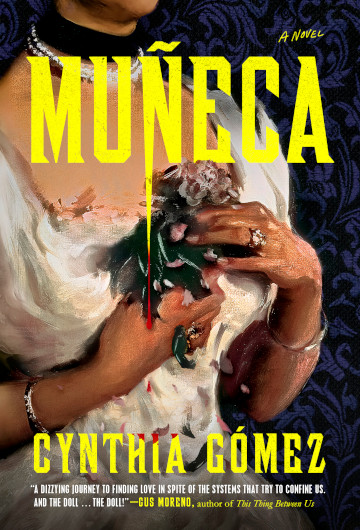
Muñeca introduces a new age within the gothic horror genre. While the novel has classic gothic elements, the plot focuses on a queer, Latine working-class witch. Author Cynthia Gómez delivers a story that’s filled with surreal and real horrors and calls out societal injustices committed against marginalized communities. This is not your typical tale of horror, and it’s one that needs to be told.
The year is 1968 and the story is set in Oakland, California. At the start, we learn that protagonist Natalia Fuentes’ mother has passed. Since losing her mom, Natalia has been on a journey of self-discovery and has found her chosen family within the queer community. Natalia decides to leave that temporarily behind, though, when she hears that Spanish heiress Violeta Miramontes has been stricken by an unknown illness and left paralyzed. Violeta’s condition is no mystery to Natalia who knows the signs of malefic witchcraft.
She intends to find a way to break the curse and set the heiress free in exchange for a nice monetary reward. Since her mother used to work as a maid for the wealthy Miramontes family, her plan is to return as a caregiver and work some magic in secret. Of course, things are never as simple as they seem. The Miramontes house holds dark secrets, spellworking turns out to be more difficult than expected, and Natalia and Violeta develop a deep affection for each other that neither saw coming.
While many horror elements unravel in the story, Gómez also manages to highlight class, race, and gender inequality that was all too common in the U.S. during the 60s and is being seen again today. Her book offers the Latine representation that’s lacking in the gothic genre. In a PR statement, the author comments, “[It] would feel right at home next to Jane Eyre or Rebecca or Wuthering Heights but, unlike those, Muñeca has a protagonist who looks like me.”
I appreciate how the novel holds a magnifying glass to marginalized communities and the injustices they face. Gómez set the narrative during a time when civil rights movements were happening and big changes were transpiring. Besides supernatural horrors, it addresses the real horrors hovering over Latines and other people of color, the LGBTQ+ community, and hired help.
In an interview with the book publisher Putnam, the author was asked why it was important to make a queer, Latine working-class woman, like Natalia, a central character in a largely Eurocentric genre. Gómez explains:
“I’ve said before that Gothic literature largely takes place in the homes of the wealthy: people whose very existence, from the food they eat to the clothes they wear, depends on the labor of dozens, if not hundreds, of unseen human beings whose work is everywhere but who almost never actually show up on the page (or the screen). It’s a deeply distorted depiction, and so I’m just putting back onto the page the people who’ve been kept off it.” -Cynthia Gómez
The author also weaves in historical events, shedding light on stolen land controversies after the Mexican American war. And she reveals the prejudice that exists between families with pure Spanish blood, like the Miramontes, and those who carry Indigenous ancestry, like Natalia and the other maids.
There’s also the attraction that grows between Natalia and Violeta. It’s a genuine, romantic connection that society during that time refused to accept. When Mrs. Miramontes, Violeta’s mother, notices Natalia’s feelings for her daughter, she says, “You can’t give her marriage or children. And do you have any idea how the world is going to treat the two of you?” (p.149) To me, those lines alone communicate the discrimination queer people encountered then and still do.
The novel even touches on the stigma of being a witch and practicing witchcraft. Natalia learned the craft as a child from her grandmother, but her mother frowned upon it. She knows she has special powers, but she doesn’t share her connection to magic with anyone for fear of being misunderstood. And she makes sure to be discreet about her spellworking while in the Miramontes home. It brought to mind how natives throughout Latin America were forced to convert to Christianity by Spanish colonizers and hide their spiritual practices.
The story is so multilayered, and yet the author says so much in less than 200 pages. If you’re wondering about the meaning of the title, Muñeca translates to “doll.” Dolls are often featured in horror stories, and the way the author incorporates a doll in the plot is fascinating.
There’s one point in the story where Natalia is sharing some sage advice given to her by her mother and says:
“…the best thing any of us can do is find what our talent is, and use it to do some good.” (Muñeca, p.64)
Cynthia Gómez is definitely doing that by writing a book that delivers so many important messages and spotlights many important issues.
Muñeca released this June and is available as a hardcover, eBook, and audio book. I highly recommend it. And keep your eye out because Cynthia Gómez is already at work on her next novel, which promises to be quite haunting.
Where to Stalk
Cynthia Gómez official website


